
Havanese Dogs
Feature Rating Trainability: Shedding: Energy: Watchdog: Children: Popularity:
Feature Rating Trainability: Shedding: Energy: Watchdog: Children: Popularity:
The Havanese is an entertaining, playful, happy, gentle, and affectionate dog. He is very attentive and will find a high place on the furniture to watch you and what you are doing. He loves to do tricks and show off for you--he likes to be the center of attention! He becomes very attached to his owner, and needs lots of human companionship. He is not a dog who should be left alone for very long. He's friendly and likes people, and is easygoing and polite with guests.
He is a fairly good watchdog because he will bark when he sees a stranger, but will quickly look to you for a signal to stop barking and go and make friends. He is well-mannered with other dogs, cats and pets. He is a trainable dog who likes to learn things and is responsive and obedient; he should have some training to make sure he doesn't get too bossy. He is sensitive to harsh words and tones, and is best taught with gentle persistence. He can be difficult to housebreak.
He is an indoor dog who is very active and playful inside the house, and loves to play with his squeaky toys on the carpet. He's less active outside, although he does need a regular leashed walk or a nice romp in the yard. He loves children and is very good and playful with them. He virtually doesn't shed, and so would be a good pet if you are a clean-freak.
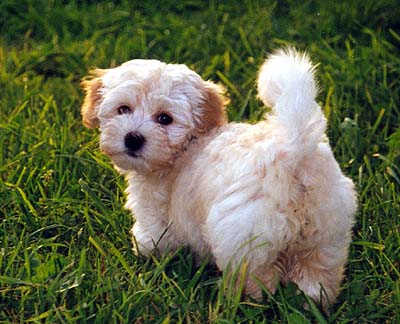
The Havanese, while a toy dog, is hardy and sturdy and does not appear fragile or overly delicate. Weight is 8-17 pounds and height 8½ -11½ inches (216 to 292 mm), with the ideal between 9 and 10.5 inches (229 and 267 mm), at the withers. The height is slightly less than the length from point of shoulder to point of buttocks, which should give the dog the appearance of being slightly longer than tall. A unique aspect of the breed is the top line, which rises slightly from withers to rump, creating a back that is straight but not level. This breed is renowned for their unusually small tongue and flashy but not too reaching gait, giving the Havanese a sprightly, agile appearance.
Havanese have dark, round eyes. The ears are medium length, well feathered and should always hang down. The tail curves over the back at rest and is covered with a long plume of fur. Havanese are non shedding and hypoallergenic, great for people with dog allergies because they have little to no dander.
Their coat should be brushed daily with failure to do so resulting in mats. Many pet owners clip their dogs into a 1-2 inch long "puppy cut" for ease of maintenance. Their hair, designed for Cuban heat, serves no protection during cold weather, so they are dogs for which one would buy a sweater. If they go out in the snow, ice clumps will stick between their paw pads; just rinse off in warm water or buy booties. When you give them a bath, make sure to dry them. Some in shorter clips can blot and air dry, but most will need to be blown dry. Use high air but low heat to protect their sensitive skin. Hot air can damage the skin.
Havanese are generally healthy and sturdy, living 14 to 19 years. Like other pure breeds, genetically-linked disorders are common due to the small genetic pool from which they owe their ancestry. Havanese organizations, such as the Havanese Club of America, monitor genetic issues to prevent propagation within the breed.
Havanese suffer primarily from liver disease, heart disease, cataracts and retinal dysplasia. Havanese sometimes tear and may develop brown tear stains, especially noticeable on white or light coats.
The coat is long, soft, light, and silky. Havanese, like other Bichons and related dogs like Poodles, have a coat that catches hair and dander internally, and needs to be regularly brushed out.
Havanese are supposed to have a slightly wavy, profuse, double coat. However, unlike other double coated breeds, the Havanese outer coat is neither coarse nor overly dense, but rather soft and light with a slightly heavier undercoat. Not all Havanese have coats that match the standard. Havanese coats are supposed to be very soft, like unrefined silk (compared to the Maltese coat, which feels like refined silk). However, in some dogs the coat can become too silky, looking oily. On the other end of the spectrum, Havanese coats can be too harsh, giving a "frizzy" appearance. The coat should always be soft to the touch - never harsh, coarse, or cottony.
Because of the tropical nature of the Havanese, the thick coat is light and designed to act as a sunshade and cooling agent for the little dog on hot days. This means that the Havanese does need protection against cold winter days, in spite of the warm look of their fur.
The coat can be shown naturally brushed out, or corded, a technique which turns the long coat into "cords" of fur, similar to what dreadlocks are in humans. This corded look may be difficult to achieve for the first timer, so it is always recommended that someone interested in cording their Havanese consults someone who has done it before.
A havanese's coat can come in many colors such as, the most common, white and brown, and the least common, black.
Pet coat: He only needs to be brushed and combed occasionally because a short pet coat won't matt or tangle. Clipped short every few months.
Show coat: Should be brushed and combed for 10 to 15 minutes daily to prevent matting and tangling and trimmed every 6 weeks.
The Havanese is the national dog of Cuba and its only native breed. He probably arrived with Spanish colonists in the 16th century, and was eventually adopted by wealthy Cuban landowners and elites.
Following the Cuban Revolution in 1959, escaping exiles brought their Havanese dogs to the United States, and eleven dogs were used to rebuild the breed in America. The Havanese was admitted to the AKC in 1995. His AKC popularity was 37th out of 157 breeds in 2007.


